
Dawson Property Tax Record Fields
A Dawson County tax record really has two halves. The assessor card comes first, and the official sample card fills in the essentials: parcel number, location address, owner of record, legal description, tax class, district, millage, acreage, neighborhood, and homestead status. The collection account with the Tax Commissioner comes second. Together they carry the parcel from valuation to the bill.
| Field | What It Shows | Where |
|---|---|---|
| Fair market value | Assessor's January 1 value basis | Board of Tax Assessors |
| Assessed value | Generally 40 percent of fair market value | Board of Tax Assessors |
| Exemptions | Homestead or specialized treatment shown on the roll | Board of Tax Assessors |
| Bill and status | Charge, payment, or delinquency | Tax Commissioner |
| District and millage | Taxing area and rate context | Assessor and Tax Commissioner records |
Georgia assesses most property at 40 percent of fair market value. Millage is simply the rate applied in the tax calculation. Keep the numbers in their lanes. Assessed value and the bill it produces say nothing about what a buyer might pay tomorrow, since a deed's price reflects a different date and its own circumstances.
Dawson Assessor and Collector Roles
The Board of Assessors, headed by the Chief Appraiser, keeps Dawson County parcel assessment data at 25 Justice Way, Suite 1201, phone 706-344-3590. Its site offers Property Search, Sales Search, a Tax Estimator, forms, and notices. County guidance notes that assessment figures come from the last certified tax roll, while other details can change.
Tax Commissioner Nicole Stewart Brooksher's office sits in Suite 1222, phone 706-344-3520, and handles billing, collection, and disbursement. The office runs its own portal for Dawson County property records. When an account will not resolve online, call the office directly for help.
Dawson Values and Millage
Fair market value is the assessor's estimate under Georgia tax law as of January 1. Assessed value is generally 40 percent of that amount. A mill represents one dollar of tax per thousand dollars of taxable value, subject to the applicable districts and exemptions. Taxable value is the figure left after lawful adjustments used for the bill.
An official 2022 ratio-study row for 229 Teaberry Lane lists a $304,019 sale, $122,912 assessment, and 40.43 ratio. Another row for 243 Payton Duncan Drive lists a $1,024,209 sale, $313,604 assessment, and 30.62 ratio. These are dated audit samples, not current values or bills.
Dawson Assessment Card Details
The sample for parcel 095 145 shows 3.19 acres, an unincorporated tax district, a 21.4225 millage rate, no homestead exemption, and an R4-Residential tax class. The card also carries two warnings. The short legal description is not for legal documents, and the tax class is not zoning.
Both warnings matter more than they look. For a legal land description, use the deed or plat. For land-use classification, go to the county or city zoning source. And a neighborhood label reading Dawsonville does not put the parcel inside city limits.
Look Up a Dawson Tax Bill
Start with the assessor to get a clean parcel ID. Then open the Dawson County tax portal and match the owner, property description, tax year, and parcel number. If the dynamic lookup fails, call or email the Tax Commissioner at taxcommissioner@dawsoncounty.org.
- Find the parcel number on the assessor card.
- Search the Tax Commissioner account for the same parcel and year.
- Compare the bill with value, district, and exemptions on the roll.
- Check official delinquency or tax-sale records when a balance is at issue.
- Assessed value
- The percentage of fair market value placed on the digest.
- Millage
- The rate used in the property-tax calculation.
- Homestead exemption
- Qualified relief tied to an eligible primary residence.
- Tax lien
- A recorded claim connected to unpaid tax.
Dawson Homestead Filing Window
Dawson County sets January 1 through April 1 as the filing window for regular homestead and specialized assessment matters. That window also covers property returns and splits or combinations. The 2026 notice listed August 3, 2026 as the final day to appeal or apply for that cycle's relief. Mark both dates if a filing is coming.
Eligibility varies by exemption. Rely on current assessor forms and staff guidance rather than a flag on the card. An exemption shifts taxable value. But it never changes the deed's recorded sale price or its ownership.
Dawson Delinquent Tax Lists
Dawson tax-sale PDFs list PID, owner, tax year, bill number, property description, and acreage. Each entry also shows a grand total. A May 2026 example covers parcel 015 060 with two tax years and bills. It adds a Sanderlin Mountain description, 1.13 acres, and a $1,747.71 grand total. Treat it as a snapshot, not a current status statement.
An entry on the list proves no sale closed and no title changed. Match the PID and legal description first. Then read the notices, redemption material, any tax deed, and later Clerk filings. Entity names appear too, so an owner-name search alone can miss or misidentify land.
The official tax lookup shell is shown below.
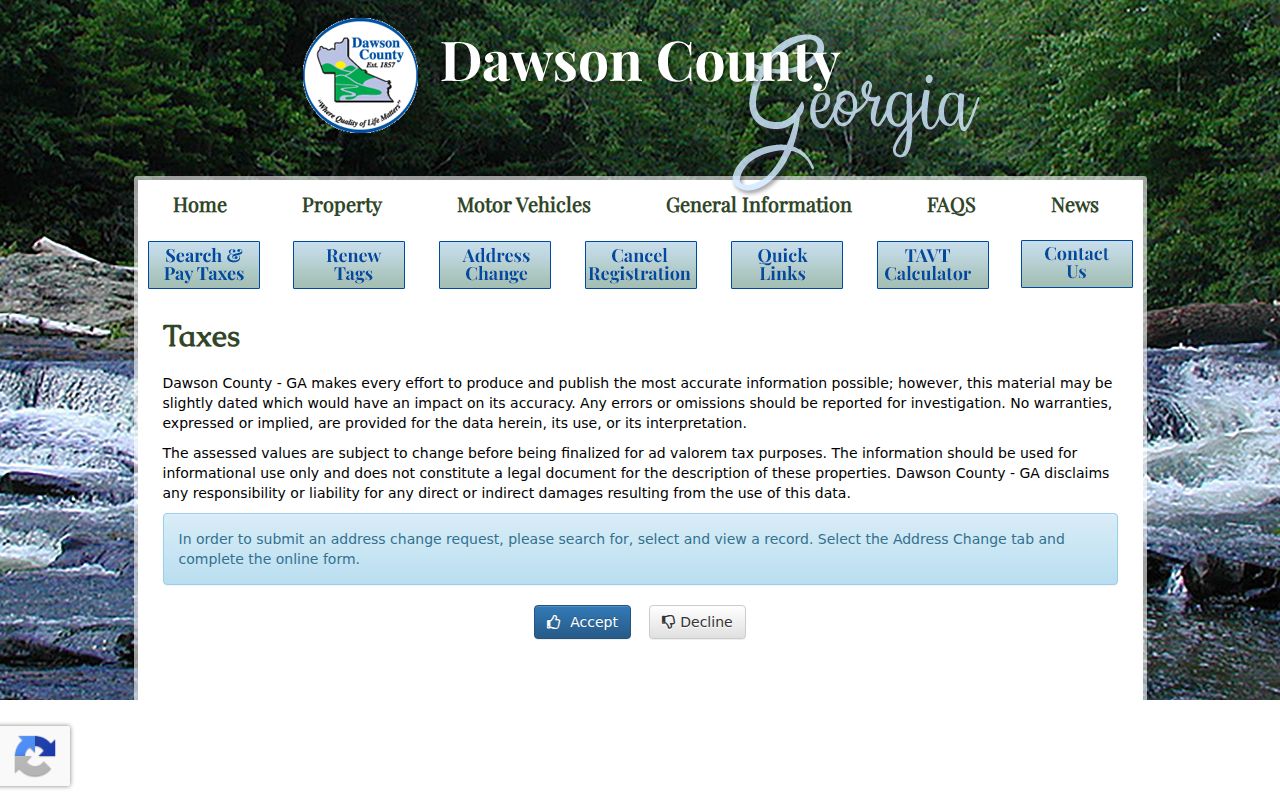
The official page confirms the access point, though account fields appear only in the live dynamic system.
Dawson Undeliverable Notices
Georgia law lets counties publish a public list for assessment notices returned as undeliverable, under O.C.G.A. §48-5-306(c). That can explain a notice that never arrived. It does not extend every deadline automatically. Ask the assessor for the notice, its mailing record, and the controlling appeal date.
A mailing address different from the property location is routine in tax records. Match the parcel. Match the owner. Do this before treating a returned-notice list as evidence about a particular tract.
Dawson Appeals Took Longer in 2024
Dawson County hit the three-percent appeal threshold under O.C.G.A. §48-5-311 on June 7, 2024. Appeals that year crossed the line in both count and value. Crossing it gave the Board 180 extra days to decide appeals and notify taxpayers. So a filed appeal could stay open well past the usual window. That was a one-time event, not the normal pace. Treat the extension as specific to that statutory trigger. Do not treat it as the timeline for every cycle. Hold onto your appeal receipt, and watch the assessor's notices for the current year's dates.
Appeal a Dawson Assessment
A Dawson County appeal can challenge value, taxability, uniformity, covenant matters, or exemptions. File with the Board of Tax Assessors by the deadline printed on the annual notice. Strong support includes the notice itself, the parcel card, corrected property facts, comparable sales, and photographs. Add a clear statement of the issue. Keep proof of delivery. The Board of Equalization route and any further review depend on which appeal path you choose. Follow the instructions in force. For 2026, the assessor set August 3 as the deadline on its official notice. One cycle's date sets no fixed annual rule.
Keep the notice, parcel card, appeal form, attachments, and delivery proof in one file. Separate factual corrections from value arguments. Wrong acreage, class, improvement detail, or parcel identity needs source records proving the error. A value or uniformity claim needs evidence tied to the valuation date. It must also show how comparable parcels were treated.
Deed records and tax mailing records update on different schedules. Compare the newest deed conveyance against the certified-roll owner and the tax bill account. If they disagree, report it as a timing issue. Ask which source has not refreshed. Never change names or parcel formats yourself while reconciling them.
Appeal window. File by the deadline stated on the Dawson County assessment notice. The published 2026 deadline was August 3, 2026, but later cycles require a fresh check.